Google has announced Gemini 4 Argon. The element's name comes from the Greek argos, meaning “lazy” or “inactive.” Given the pace of model releases, that sounds like reasonable advice for the first few days: leave the model setting alone.
I still want to read the benchmarks and try the model. I just would not treat the announcement as a production migration date. In its September 30, 2026 announcement, Google said initial access would go to selected cybersecurity defenders and gave no date for a wider release. As of October 2, most developers cannot run Argon on their own work. We can use that time to decide what we will need to learn when we can.
Benchmarks are where I start
I like benchmark results. They help me decide whether a new model deserves a closer look. As of October 2, Argon led the preliminary Text Arena ranking but placed lower on the Code Arena WebDev board. The rankings can change, and each measures different work. The relevant question is which of those tasks resembles what I need the model to do.
Even a benchmark close to my work will not run against my repository or follow my review process. A model might lead a table and still create more work for me in code review. Another might rank lower overall but handle a task I do every week more reliably. Google reports 77.9% on DeepSWE v1.1 for Argon. I take that as a meaningful result on a defined evaluation, not evidence that my agents are ready to switch.
This is the line between following a release and changing a working environment. The announcement sends me to the documentation. The migration decision has to come from tasks whose outcome I am responsible for.
My agents do not work alone
I use Claude and Codex together and have them review each other's output. Around them sit skills, project rules, and hooks. That means I care about more than the first answer a new model gives me. I care which tools it selects, what files it changes, how it explains a decision, and what the other model catches when it reviews the work.
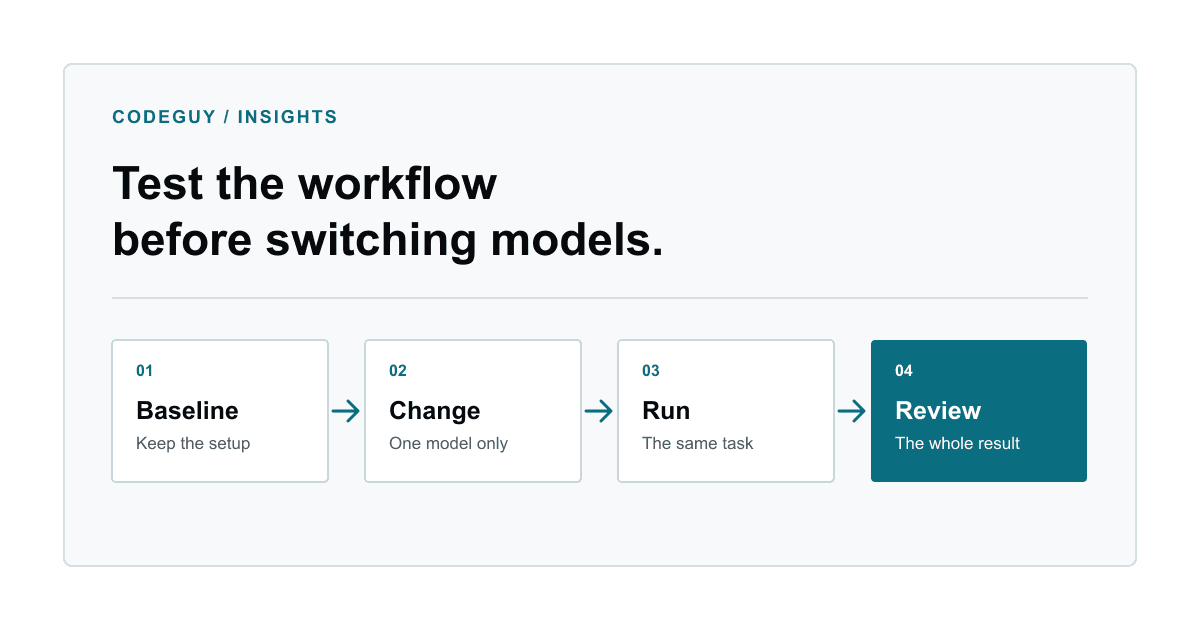
Changing one model in that arrangement also changes what the other model receives. A different first draft can change the review. If I replaced both models, rewrote the skills, and adjusted the hooks at the same time, I would have little idea which change caused the first regression. I would rather keep one role steady while testing the other: the same task, the same instructions, one new model. Then I can judge a change instead of guessing at one.
I would inspect the review itself, too. Did the second model flag an error the review is meant to catch? Did it notice an edit outside the request, or merely praise the answer? The point of having one model check another is that it may find what the first missed. If that ability disappears, a more polished first draft may not improve the workflow at all.
A passing test alone would not settle it. Imagine a hypothetical form change. The agent produces a component that looks correct and passes the suite, but it edits an unrelated page. Or it sends form content to an outside tool that had no reason to receive it. The output may appear complete while the path to it crossed a boundary the team relies on. This is an illustration of what I would inspect, not a claim that I have tested Argon or seen this happen on a client project.
The cost of a migration also grows with the number of relationships in the setup. If one model drafts and another reviews, I need to know whether the reviewer still catches the errors it was assigned to catch. I need to know whether a hook is checking the right output and whether a skill still triggers at the right moment. A vendor can test its own model. It cannot test my exact arrangement of tools and instructions for me.
Why the old instructions exist matters
A newer model may read an old instruction differently. A reminder that helped an older model remember to run a check could become unnecessary. It might cause extra tool calls. Other rules need to stay because they protect the project regardless of which model is running. “Remember to check your work” and “do not send sensitive data to an external service” have different jobs.
There is model-specific guidance for this. Google's Gemini 3 migration documentation suggests simplifying certain older prompts and checking particular input types. Anthropic notes that prompts meant to push an older model towards more tool use can make a newer one overdo it. Those are concrete reasons to review the affected parts of a setup. They do not amount to a universal instruction to rewrite every skill, rule, and hook whenever a major model appears.
So I would begin with the purpose of an instruction. If it enforces a boundary, it stays in force during testing. If it only compensates for an old model's habit, I can test whether it is still needed. I would change the instruction after finding a reason, not because the release calendar says it is time to “optimize” the whole harness. Reworking instructions that already do their job costs time and tokens too.
What would earn a place in production
I would prepare repeatable tasks drawn from normal work. The set should contain more than polished demos: an incomplete request, a change across several files, and a case where the agent should stop for a human decision. For each task I would keep the result from the current setup and state a boundary the new model must not cross. I would compare the quality of the outcome, the scope of the changes, the cost, and how much review work remained for me.
The first run with a new model would keep the existing skills, rules, and hooks. If it goes badly, I can look for the first point where the behaviour diverged. Did the agent choose the wrong tool? Ignore an instruction? Change more than the task required? Or was the hook checking something different from what I assumed? That answer points to the part of the setup worth changing. If I replace the model and rebuild the harness in one move, I lose the comparison.
Good output still has to make operational sense. It may arrive more slowly or cost more. It may take so much manual review that the gain disappears. If repeated runs of the same task produce inconsistent outcomes, I would not select the best one and call the migration done. If the model crosses a security boundary, a higher benchmark score does not make up for it.
The amount of checking should reflect the impact of the work. For personal chat, where I read each answer, a few familiar questions may be enough. For an agent that writes to a repository under rules shared by a team, I want comparable tasks, a visible record of changes, and a way back. Testing has a cost of its own; I do not need a large process simply because a launch generated a large headline.
Model vendors understandably show where a new release performs well. Their benchmarks and migration guides serve a broad audience. They cannot know which actions my agents may take without approval, what my cross-model review is meant to catch, or how much cleanup a change creates. The decision about my particular workflow stays with me and the team using it.
Before a production switch I would want to know who approves it, who watches for problems that did not appear in the first test, and who can restore the previous model. A green first run answers none of those questions. For a shared setup, I would begin with work whose output is easy to inspect and leave other tasks on the existing model. There need not be a single moment when the entire environment changes over.
Until Argon is available for my own tasks, I cannot say whether it improves them. I can choose the work that would answer that question and keep the current setup running. If the new model performs better without crossing the boundaries that matter, I will adjust only the parts that need it. Then I can consider production use. If the improvement does not appear, there is nothing I need to rebuild.